How to Choose the Right Tech Stack for Your Web App

Every new project starts with the same question: what tech stack should we use? Founders Google it. They ask developer friends. They read comparisons that end with "it depends." And then they pick something based on whoever they hired last.
There's a better way. Here's a practical decision framework we use at XVerse Tech before writing a single line of code.
Start With What You Actually Need to Ship
The biggest mistake is choosing a stack based on what's popular, not what fits your specific product. Before picking any technology, answer these three questions:
- What is your primary interface? Is it a browser-based app, a mobile app, an API consumed by others, or a dashboard?
- What does your data model look like? Is your data relational (users, orders, products) or document-like (flexible schemas, nested structures)?
- How fast do you need to move? MVP in 6 weeks has different constraints than a production system expected to handle 10,000 concurrent users.
Most early-stage web apps fall into the same category: browser-based, relational data, and need to ship fast. That narrows your options considerably.
The Default Stack (and Why It Works)
For most web applications, we default to this combination:
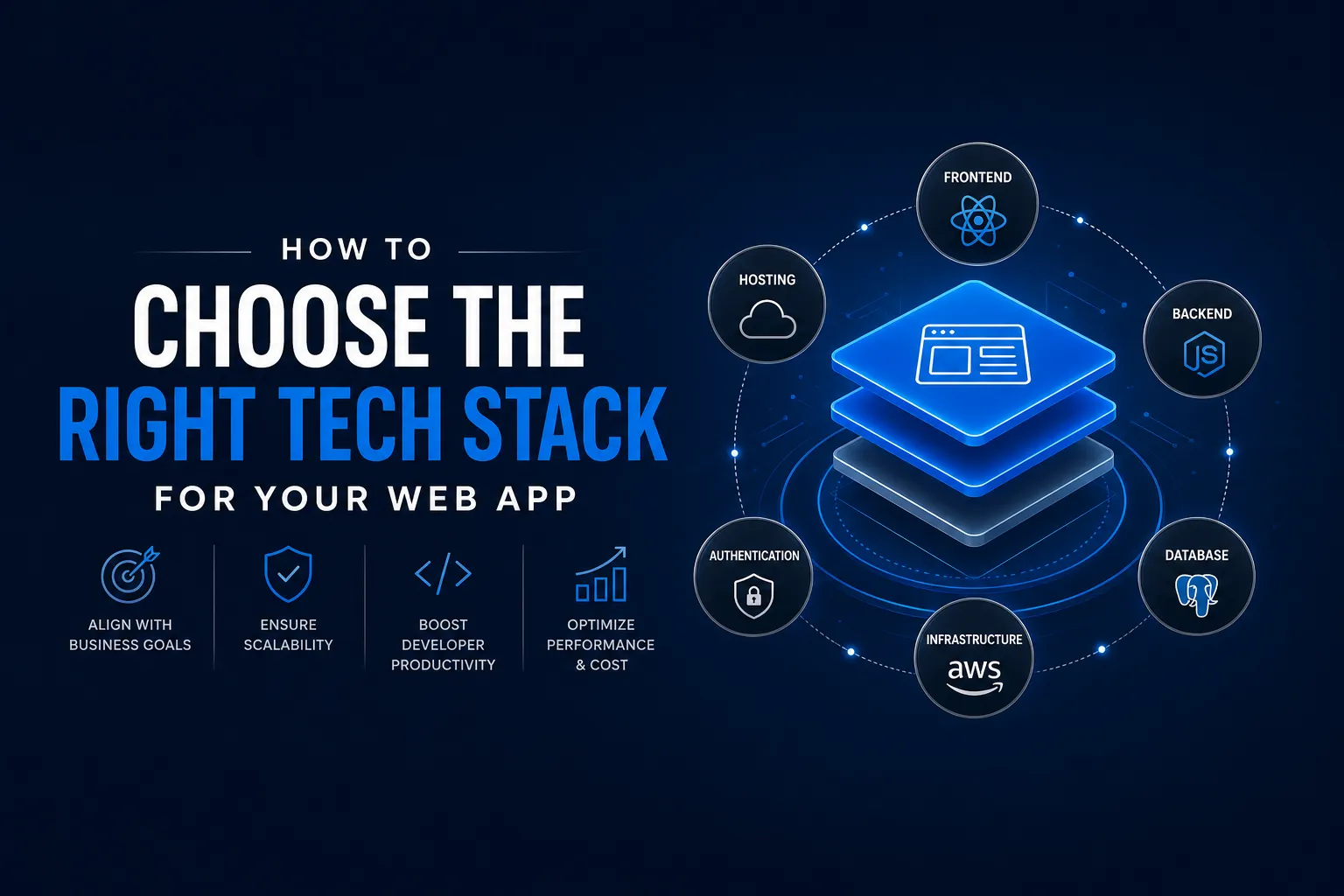
- Frontend: React or Next.js — React has the largest ecosystem of any frontend framework. Next.js adds server-side rendering, routing, and API routes in one package. If you need SEO or fast initial page loads, Next.js is the answer.
- Backend: Node.js or Python (FastAPI) — Node.js is the right choice when your team is already JavaScript-heavy. Python with FastAPI wins when you need ML integrations or your team has strong Python experience.
- Database: PostgreSQL — Postgres is the most capable open-source relational database available. It handles JSON, full-text search, geospatial data, and complex queries. Start here unless you have a specific reason not to.
- Cloud: AWS (or GCP for ML-heavy apps) — AWS has the broadest service coverage. Elastic Beanstalk or ECS handles container deployments, RDS manages your Postgres instance, and S3 handles file storage. GCP becomes preferable when you're doing significant ML work and want tight Vertex AI integration.
This stack isn't sexy. It won't make headlines. But it's proven at scale, has deep talent availability, and won't surprise you with unexpected limitations six months after launch.
When to Deviate
There are legitimate reasons to go off the default path:
- Real-time features (chat, live collaboration, gaming): Consider adding WebSockets via Socket.io or moving parts of your backend to Elixir/Phoenix for its concurrency model.
- Extremely high read throughput: Introduce Redis as a caching layer before you consider switching databases.
- Flexible or evolving schemas: MongoDB makes sense when your data structure genuinely varies across records. Not just because it "feels simpler" upfront.
- Edge performance: Next.js edge runtime or Cloudflare Workers when latency is critical and you're serving a global audience.
What Doesn't Matter as Much as You Think
Founders often agonize over decisions that rarely affect outcomes:
TypeScript vs JavaScript: TypeScript is worth it for teams of 3+ or projects that will be maintained long-term. For a 6-week MVP with one developer, it adds overhead without proportional benefit. Make this call based on team size, not ideology.
SQL vs NoSQL: Start with PostgreSQL. You can always add a document store later. The reverse — migrating from NoSQL to relational — is much more painful.
Microservices vs monolith: Build a monolith first. Extract services when you have a specific scaling problem that proves it's necessary. Premature microservices are one of the most common causes of project delays we encounter.
The Decision Checklist
Before finalising your stack, run through this:
- Does your team have existing experience with this stack? (Familiarity beats theoretical superiority.)
- Can you hire for this stack in your market if needed?
- Does this stack have active maintenance and a community that will answer questions on Stack Overflow at 2am?
- Have you validated your core product assumption yet? If not, optimise for speed of iteration above everything else.
The best tech stack is the one your team can build fast and maintain confidently. Second-guess that only when you have a specific technical requirement that forces your hand.
What We See in Practice
Across 80+ products shipped, the projects that struggled with tech stack choices usually made one of two mistakes: they over-engineered for scale they never reached, or they under-invested in the database layer and paid for it in complex migrations 12 months later.
Pick boring, proven technology. Ship your product. Optimise based on real usage data, not predictions.
Ready to build?
Need Help Picking the Right Stack?
Book a free 30-minute call with a senior XVerse engineer. We'll assess your requirements and tell you exactly what we'd build — and why.
Book a Free Call →